Ruth Warnecki
Point BlankRuth Warnecki is a Federal Bureau of Investigation special agent whose methodical curiosity first leads her into Winkel’s Cave in search of a possible treasure, then draws her back into an investigation shaped by a murder, a dangerous drug, and her own missing memories. Rescued near Dixon Noble’s home without knowing who she is, she gradually recovers her identity and uses the same attention to detail that guided her underground to help expose the human causes of the danger surrounding her.
Identity and Background
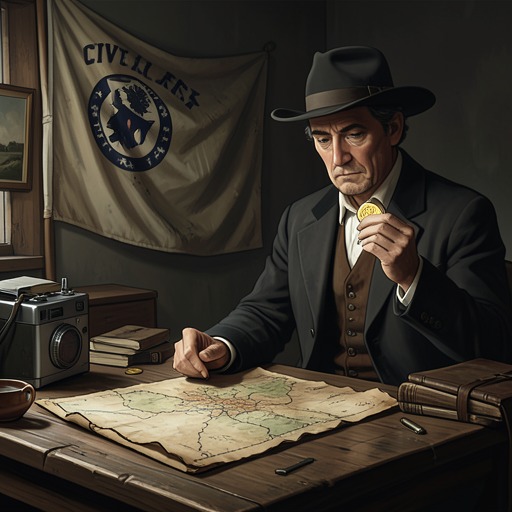
Before the cave incident, Ruth is a practiced treasure hunter as well as an agent. Her map of Winkel’s Cave is worn and stained from repeated use, including a smear of strawberry jam; she has checked its measurements carefully and carries a metal detector and extra flashlights. At the point where the map indicates an opening, she verifies her position and searches the limestone wall with her hands, but finds no arch. Rather than treating the failed search as proof that the map must be genuine, she recognizes that false maps are common in treasure hunting.
Her caution coexists with hope. The map has drawn her attention because research into its paper, ink, and handwriting suggests that it is about 150 years old. Her uncle Tobin Jones, a treasure hunter of fifty years and a mentor to her, has taught her that many maps are fraudulent and that treasure seekers are often taken in. Ruth has absorbed the warning without giving up the pursuit: she checks distances closely, uses practical equipment, and accepts disappointment as part of the work. In the cave, she hums when frustrated rather than cursing, a small sign of a composed, self-directed temperament.
Rescue and the Return of Her Identity
After the cave ordeal, Dixon Noble finds Ruth unconscious in the snow-covered woods near his home. His dog, Brewster, has discovered her; Dixon checks that she is alive and brings her into the care of his household. He identifies himself as the sheriff of Maestro and introduces his son Rob. When he asks Ruth her name, she cannot supply one. She is frightened by the blankness, and Dixon suggests that the blow to her head may explain her inability to remember. She has no identification in her pockets to settle the question.
At first, the name attached to her in Dixon’s home is Madonna, reflecting the unfamiliar identity she has been using while her memory is absent. Dixon eventually tells her that her name is Ruth. That knowledge does not immediately restore the rest of her past. The decisive recognition comes when her FBI colleagues Dillon Savich and Lacey Sherlock arrive. Ruth recognizes Savich, embraces him, and says that she remembers; seeing him and Sherlock brings her identity and memories back. She is then able to identify Dixon as the sheriff who has cared for her and to acknowledge Rob and Rafe Noble, who have also looked after her. The return is both personal and practical: the stranger in Dixon’s house can now explain who she is and why someone may be trying to kill her.
Ruth connects the attempted killing to the treasure in Winkel’s Cave. Her memory is still incomplete, however, and the cave remains both the place where she lost her sense of self and the location of evidence that can restore the sequence of events. The contrast gives her recovery an investigative dimension: identifying herself is not the end of the mystery but the condition that lets her re-enter it as an agent.
The Cave, the Drug, and Recovered Clues
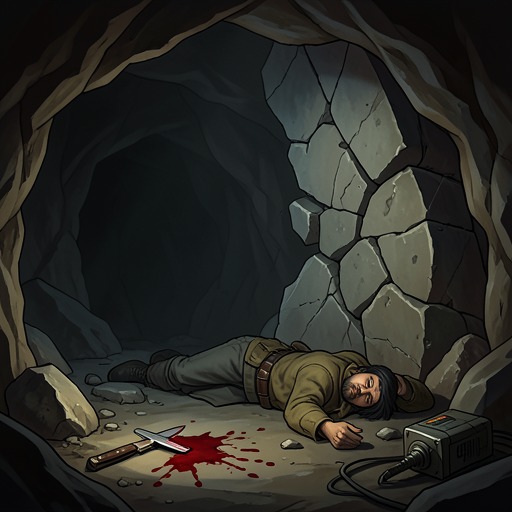
When the investigators return to the cave, Ruth recognizes a faint jasmine scent and remembers smelling it on the Friday she was there before. Following the scent farther into the cavern, she notices that it grows stronger alongside an unpleasant odor. She stumbles over something and discovers the body of a young woman, later identified as Erin Bushnell. Ruth recognizes that the jasmine perfume belongs to the dead woman and that the other smell comes from the body. Her senses, first recalled as fragments, have led her to a crucial discovery.
A second clue comes through Ruth’s compass. When Dixon gives it to her, Savich encourages her to remember the last time she held it. The object brings back a moment of terror: Ruth recalls hearing a slithering sound approaching across the cave floor, then running and screaming. The compass functions as a concrete link to the cave and to the memory she cannot otherwise summon. Her recollection does not yet explain who was present or exactly what happened, but it establishes that she fled from a perceived threat rather than simply becoming lost.
The medical evidence supplies another part of the explanation. The medical examiner reports that Ruth’s remaining blood sample contains the same drug found in Erin Bushnell. Dixon explains that BZ, also known as quinuclidinyl benzilate, is a colorless, odorless substance that can cause confusion, hallucinations, forgetfulness, and stupor. That finding makes Ruth’s memory loss part of the case rather than an unrelated consequence of the cave search. It also links her experience to the circumstances surrounding Erin’s death.
Ruth later offers a careful reconstruction rather than claiming certainty. She and Dixon believe she inhaled or touched the drug used on Erin, fell, and struck her head. Ruth thinks she must have recovered enough awareness to find a route out after the attackers had left, without being seen by them. She then wandered through the woods and collapsed near Dixon’s home, at least four or five miles from the cave. The precise route remains unexplained, but her account joins the drug exposure, head injury, escape, and rescue into a plausible sequence while preserving what neither she nor Dixon can establish.
Work in the Investigation
Once her identity is restored, Ruth returns to her professional role without losing the personal connection formed during her recovery. In Maestro, she introduces herself as a special agent with the Federal Bureau of Investigation, correcting a local assumption that she works in private security. Her public identity is no longer a name supplied by others; she can state her position herself and take part in the work surrounding the murders.
At Stanislaus, Ruth and the investigators question Helen Rafferty about Dr. Holcombe and Erin Bushnell. Ruth presses the importance of the matter because Erin is dead, and Helen becomes upset before regaining her composure. Ruth’s direct approach helps establish the seriousness of the interview, while the account of the questioning also shows her working smoothly with Dixon and the others as part of a team.
Ruth and Dixon later search Gordon Holcombe’s office, house, and studio, examine his records, and speak by telephone with three former lovers, who were elsewhere at the time of the murders. The search does not immediately resolve their suspicions: Dixon remains troubled by the fact that two victims had been Gordon’s lovers and plans to question him again. The investigation therefore advances through both physical searches and a willingness to keep testing an apparent explanation rather than treating suspicion as proof.
A later review of Helen’s financial and telephone records shifts the inquiry. Ruth and Dixon find three large cash withdrawals in the preceding three weeks and calls between Helen and Tommy Dempsey, including two calls from Helen to a number belonging to him and one call from his number to hers. Dixon describes these records as a trail left by an inexperienced criminal. Ruth explains why Helen might have acted against Erin: Erin was different from Gordon’s other student lovers, appearing to be the woman he genuinely loved and might keep in his life. The evidence and Ruth’s interpretation identify Helen’s motive as tied to the change in Gordon’s attachment, not simply to his earlier pattern of relationships.
Relationships and Narrative Role
Dixon’s care gives Ruth a place of safety during the interval when she cannot name herself. His sons Rob and Rafe share in looking after her, and Brewster’s discovery of her makes the dog part of the chain that brings her back from the woods to human company. Ruth’s gratitude toward them is explicit after her memory returns: she identifies Dixon as her caretaker and recognizes that the boys helped care for her too. The household is not merely a stop between the cave and the investigation; it is where her identity can be recovered without demanding that she remember it on command.
Her connection with Savich and Sherlock marks the return of her established life. Ruth’s immediate recognition of her colleagues, and her expansive relief at seeing them, contrasts with her earlier inability to answer Dixon’s simple question about her name. Their arrival restores more than a professional context: it releases a continuity of memory that she had lost. Yet the story does not make recovery a clean erasure of what happened. The jasmine, the compass, the drug evidence, and the uncertain escape remain necessary pieces of her account.
Ruth’s role consequently joins vulnerability with investigative competence. She is exposed to the same danger being investigated, and at first cannot explain her own survival; at the same time, her measurements, sensory recollections, recovered memories, interviews, and review of records help move the case forward. The cave’s false-looking map, the vanished opening, and the later discovery of Erin’s body place her habits of careful checking at the center of the mystery. Her return to herself is not separate from solving the case: memory comes back through colleagues and objects, while the facts she recovers help show why she was targeted and how she escaped.